Hardware Enthusiast Overcomes Linux PCIe Memory Mapping Constraints
A developer has released a custom Linux kernel module to manage Resizable BAR memory allocation for a high-density GPU setup.
 🔌Chips & Hardware
Photo: Hacker News Front Page
Key points
- Custom Linux module enables 32 GB Resizable BAR mapping for six-GPU systems.
- Kernel regression in memory window calculation prevents proper allocation for high-density PCIe switches.
- Workaround forces manual BAR resizing and bus rescanning before driver initialization.
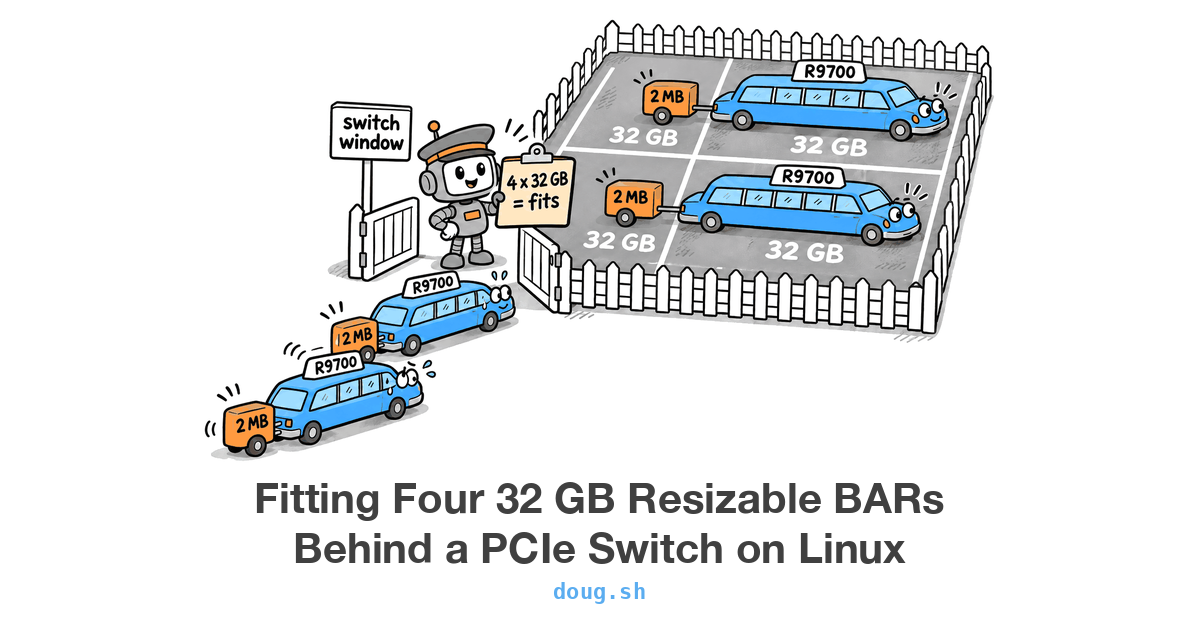
A hardware enthusiast has successfully configured a system featuring four AMD Radeon AI PRO R9700 GPUs and two NVIDIA RTX 3090s behind a single PCIe switch. To enable peer-to-peer communication, the setup requires each card to map its full 32 GB of memory via Resizable BAR (Base Address Register). However, current Linux kernel resource allocation logic fails to properly calculate the memory windows for such a high-density configuration, leading to boot failures.
The issue stems from the kernel's pbus_size_mem function, which incorrectly sums the required memory windows without accounting for necessary alignment gaps between the GPUs and their associated doorbell registers. This results in the system failing to allocate sufficient address space for all six cards. While a pending patch series from maintainer Ilpo Järvinen addresses the underlying regression, the hardware still requires manual intervention to resize BARs before GPU drivers initialize.
To resolve this, the developer created a custom kernel module, gpu-rebar-layout, which executes during the initramfs stage. The module manually sets the BAR size registers and triggers a bus rescan, effectively forcing the kernel to reallocate resources correctly. This workaround ensures that each GPU receives the necessary 32 GB window, enabling the system to function despite the limitations of the current BIOS and kernel implementation.
Source Hacker News Front Page — doug.sh/posts/gpu-bars-behind-a-pcie-switch/ ↗
Read next
 🧠AI Analysis
Fitbit Users Report Missing Health Metrics Following Recent Update
Fitbit users are encountering a bug in the Google Health app that hides crucial health data following recent software updates.
 🧠AI Analysis
Nvidia Ousts CEO Jensen Huang Amid Geopolitical and Misconduct Scandal
Nvidia has removed CEO Jensen Huang following revelations of personal misconduct involving an individual suspected of espionage and chip smuggling.
 🌐Work & Society
AWS Introduces Migration Toolkit for Amazon Bedrock Managed Knowledge Base
Amazon Web Services has released a migration guide within its Agent Toolkit to help teams transition from customer-managed to managed knowledge bases on Amazon Bedrock.
 🌐Work & Society
Donald Trump Proposes Former Apple Chief Tim Cook to Lead Nvidia
Following Jensen Huang's resignation, U.S. President Donald Trump has suggested that former Apple CEO Tim Cook take over leadership of Nvidia.
 🌐Work & Society
AWS highlights Agent-to-Agent protocol for cross-organizational AI collaboration
Amazon Web Services has detailed a reference architecture utilizing the Linux Foundation's Agent-to-Agent protocol to enable secure collaboration between AI agents across…
 ⚖️Regulation & Policy
Amazon Introduces Fine-Grained Access Controls for Bedrock AI Agents
Amazon Web Services has detailed a security approach for enterprise AI agents using Amazon Bedrock, ensuring assistants only retrieve documents authorized for specific us…