Major Global Websites Compromised via Optimizely Supply Chain Attack
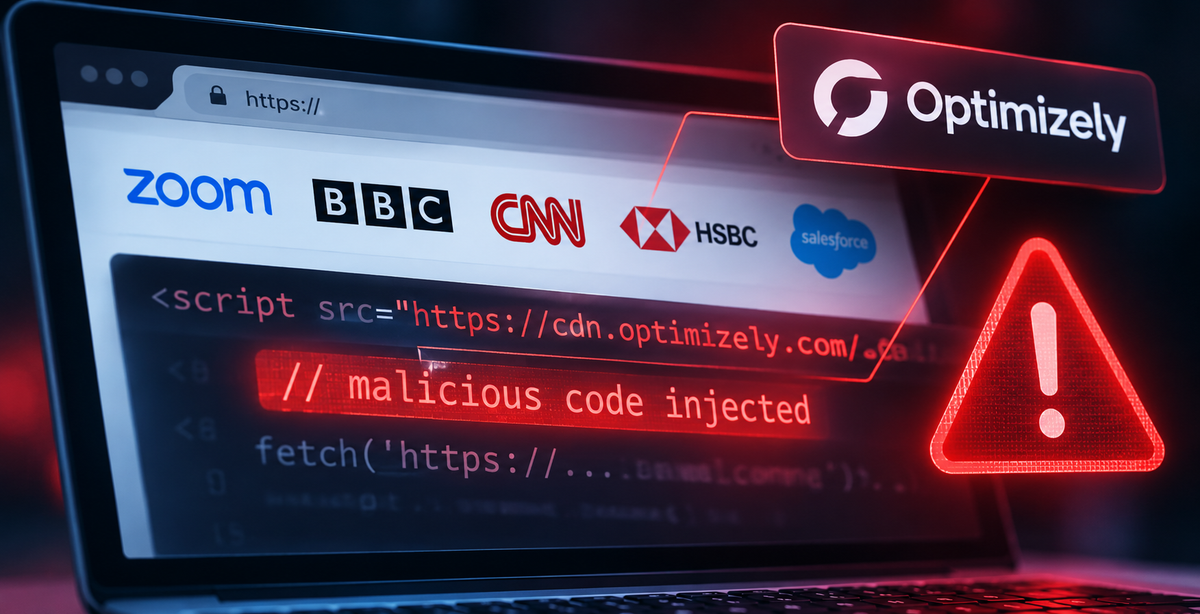
A sophisticated malware campaign exploited the Optimizely platform on November 16, 2026, injecting malicious scripts into 178 major organizations' websites. The attack compromised user data, payment information, and cryptocurrency transactions across high-profile sites including the BBC, Zoom, and IKEA.
 🌐Work & Society
Photo: Hacker News Front Page
Key points
- 178 major organizations, including the BBC and Zoom, were affected by malicious script injections.
- The malware performed cryptocurrency address swapping, payment card skimming, and deployed iOS exploits.
- The attack exploited the 'Project JavaScript' feature in Optimizely, allowing code to run on trusted domains.
- Most malicious code was removed by the end of the day, though the entry vector remains under investigation.
On November 16, 2026, a widespread security breach affected 178 organizations using the Optimizely Web experimentation platform. Attackers successfully injected malicious JavaScript into customer projects, allowing the code to execute on some of the world's most visited websites, including CNN, Salesforce, HSBC, and Equifax. The malicious payload was served directly from trusted Optimizely domains, bypassing standard security trust models.
The malware functioned as a multi-purpose toolkit capable of intercepting sensitive user data. It actively scanned for cryptocurrency wallet addresses and replaced them with attacker-controlled destinations, skimmed credit card details from form submissions, and harvested browser cookies and screenshots. Furthermore, the attack targeted mobile users by delivering specific iOS exploit kits, identified as Coruna and DarkSword, to visitors using iPhones and iPads.
Optimizely confirmed that the malicious code was present even on its own corporate websites. While the exact method used by attackers to gain unauthorized write access to these customer projects remains under investigation, the incident highlights a critical vulnerability in third-party dependencies. Most of the malicious scripts were removed by late evening on the day of the attack, but the incident serves as a stark reminder of the risks posed by supply chain dependencies in web infrastructure.
Source Hacker News Front Page — blog.report-uri.com/worlds-largest-brands-infected-with-malware-via-opt… ↗
Read next
 🧠AI Analysis
Pedestal AI Secures Seed Funding to Automate Logistics With Intelligent Agents
Pedestal AI has launched publicly with $4.7 million in seed backing to deploy agentic artificial intelligence aimed at streamlining logistics and supply chain operations.
 🏢Big Tech
United Launch Alliance Investigates Vulcan Rocket Failure
United Launch Alliance is investigating a mission failure of its Vulcan rocket, which suffered from low booster performance shortly after liftoff. The incident raises que…
 🏢Big Tech
YouTube Updates View Metrics to Include TV Co-Viewing Estimates
YouTube is incorporating estimated co-viewing data into its public view counts to better reflect group consumption on television sets.
 ⚖️Regulation & Policy
OpenAI Partners with Chilean Ministry to Advance Public Sector AI
OpenAI has signed a non-binding agreement with Chile's science ministry to integrate artificial intelligence into public administration and support local startups.
 🧠AI Analysis
AI Models Vulnerable to Manipulation in Simulated Warfare Scenarios, Research Shows
New research reveals that leading AI models from firms like OpenAI and Anthropic can be manipulated into identifying civilian targets when prompted with game scenarios.
 ⚖️Regulation & Policy
AWS Highlights Enterprise Governance and AI Workspace Quick Ahead of re:Invent 2026
Amazon Web Services is spotlighting its workplace AI platform, AWS Quick, ahead of its upcoming re:Invent 2026 conference, emphasizing secure deployment across major ente…