Nvidia, IBM, and US Laboratory Partner to Develop Hybrid Quantum Platform
Nvidia has teamed up with IBM and Fermilab to connect high-performance AI servers with quantum processors to tackle complex physics problems and quantum error correction.
 ⚖️Regulation & Policy
Photo: thenextweb.com
Key points
- Nvidia, IBM, and Fermilab are building a joint platform linking AI supercomputers with quantum hardware.
- The collaboration focuses on quantum error correction and scientific workloads in high-energy physics.
- Nvidia released a decoder tool in its CUDA-Q library aimed at drastically shortening quantum simulation times.
Graphics hardware maker Nvidia is partnering with IBM and the US Department of Energy’s Fermi National Accelerator Laboratory to construct a hybrid quantum research platform. Announced early this week, the project integrates Nvidia DGX B200 systems alongside IBM quantum processors, featuring IBM's high-speed Nighthawk chip, to test how classical hardware and quantum systems can scale together for nuclear and high-energy physics applications.
Addressing Quantum Hardware Limitations
A key focus of the initiative is solving error-correction obstacles that currently restrict the scope and runtime of quantum computations. Fermilab will steer research into decoding algorithms and system requirements necessary for future fault-tolerant quantum architectures. In tandem with the announcement, Nvidia introduced a software decoder called TCBP-JOBS within its CUDA-Q QEC 0.9.0 library. The company claims the algorithm executes up to 13,000 times faster than current benchmark methods, reducing certain quantum system design workloads from nearly three months to under 45 minutes.
Neither partner disclosed financial terms or an official launch timeline for the project. Anna Grassellino, chief technology officer at Fermilab, referred to the initiative as a proposed platform, while IBM Fellow Jerry Chow noted that linking classical and quantum technologies creates new possibilities for scientific research. In a separate effort funded by Japan's NEDO agency, IBM and the RIKEN institute connected quantum hardware with Nvidia-powered supercomputers to model molecular interactions involving over 12,000 atoms for pharmaceutical applications.
To make hybrid systems easier to operate, Nvidia and IBM are also adding quantum job-scheduling tools directly into Slurm, an open-source management software widely used by scientific computing facilities. What to watch next: Researchers will track whether the partners establish concrete deployment dates and if Slurm's new features become the standard operational interface for hybrid supercomputing centers.
Source thenextweb.com — thenextweb.com/news/nvidia-ibm-fermilab-quantum-codesign-platform-decod… ↗
Read next
 🧠AI Analysis
Pedestal AI Secures Seed Funding to Automate Logistics With Intelligent Agents
Pedestal AI has launched publicly with $4.7 million in seed backing to deploy agentic artificial intelligence aimed at streamlining logistics and supply chain operations.
 🏢Big Tech
United Launch Alliance Investigates Vulcan Rocket Failure
United Launch Alliance is investigating a mission failure of its Vulcan rocket, which suffered from low booster performance shortly after liftoff. The incident raises que…
 🌐Work & Society
US Southwest Hydropower Output Hits Record Lows Amid Persistent Drought
Hydropower generation in the US Southwest dropped 28% below the 10-year average this summer as record-low water levels in the Colorado River Basin threaten regional energ…
 🏢Big Tech
YouTube Updates View Metrics to Include TV Co-Viewing Estimates
YouTube is incorporating estimated co-viewing data into its public view counts to better reflect group consumption on television sets.
 🏢Big Tech
Apple Services Experience Widespread Outage
Apple users are reporting significant disruptions across iCloud, the App Store, and other core services, despite initial discrepancies in the company's status reporting.
 🌐Work & Society
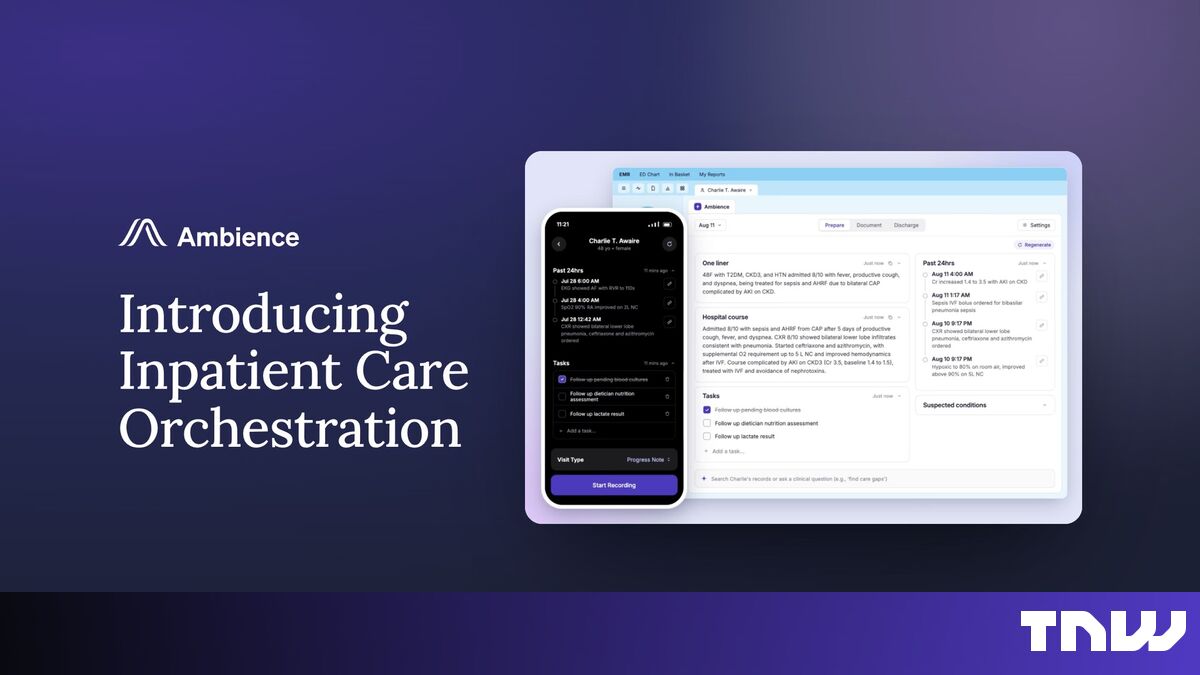
Ambience Healthcare Expands Clinical AI Suite for Hospital Operations
Ambience Healthcare has launched new AI tools designed to assist hospital staff with patient rounding and discharge planning, aiming to improve both clinical efficiency a…