OpenAI Expands Academic Grant Program to Reach 200,000 Researchers
OpenAI is offering 50,000 new ChatGPT grants for academic researchers starting November 23, switching new recipients to the Plus tier to broaden global access.
 🧠AI Analysis
Photo: thenextweb.com
Key points
- OpenAI is adding 50,000 grants covering up to 150,000 individuals, raising its total reach target to 200,000 researchers.
- Applications open November 23 on a first-come, first-served basis, providing ChatGPT Plus instead of the pilot's Pro tier.
- An internal survey of 1,800 participants showed heavy reliance on AI for writing and reading, though OpenAI noted hardware and funding limits still dictate research speed.
OpenAI has announced an expansion of its academic research initiative, offering 50,000 additional grants to provide scientists with free access to its artificial intelligence tools. Applications for the program open on November 23 and will be awarded to eligible applicants on a first-come, first-served basis rather than through a lottery. Each grant covers a primary researcher and up to two collaborators, expanding the overall goal of the initiative to reach 200,000 researchers worldwide.
The updated program introduces a plan change for incoming participants. While early pilot recipients received access to ChatGPT Pro, new grant holders will receive the lower-cost ChatGPT Plus subscription. OpenAI stated that usage data from the pilot indicated most researchers remained within Plus limits, enabling the company to stretch its resources and accommodate a larger number of research teams across 33 participating countries.
Alongside the expansion, OpenAI published internal study data reviewing more than 1,800 scientists who participated in the initial phase. Reading and learning accounted for 28% of scientific messages sent to the model, while writing tasks comprised 27%. Surveyed researchers reported that their work would take nearly twice as long without AI support, though OpenAI noted that self-reported speed gains do not prove faster scientific discovery, citing institutional limits such as funding, staffing, and physical lab space. The expansion comes as rivals Anthropic and Google DeepMind continue building out dedicated AI tools for academic research labs.
What to watch next: As applications open on November 23, industry observers will monitor whether the lower limits of the ChatGPT Plus tier satisfy academic research demands compared to the original Pro tier.
Source thenextweb.com — thenextweb.com/news/openai-chatgpt-academic-researchers-50000-grants-pl… ↗
Read next
 🏢Big Tech
United Launch Alliance Investigates Vulcan Rocket Failure
United Launch Alliance is investigating a mission failure of its Vulcan rocket, which suffered from low booster performance shortly after liftoff. The incident raises que…
 🌐Work & Society
US Southwest Hydropower Output Hits Record Lows Amid Persistent Drought
Hydropower generation in the US Southwest dropped 28% below the 10-year average this summer as record-low water levels in the Colorado River Basin threaten regional energ…
 🏢Big Tech
YouTube Updates View Metrics to Include TV Co-Viewing Estimates
YouTube is incorporating estimated co-viewing data into its public view counts to better reflect group consumption on television sets.
 ⚖️Regulation & Policy
OpenAI Partners with Chilean Ministry to Advance Public Sector AI
OpenAI has signed a non-binding agreement with Chile's science ministry to integrate artificial intelligence into public administration and support local startups.
 🌐Work & Society
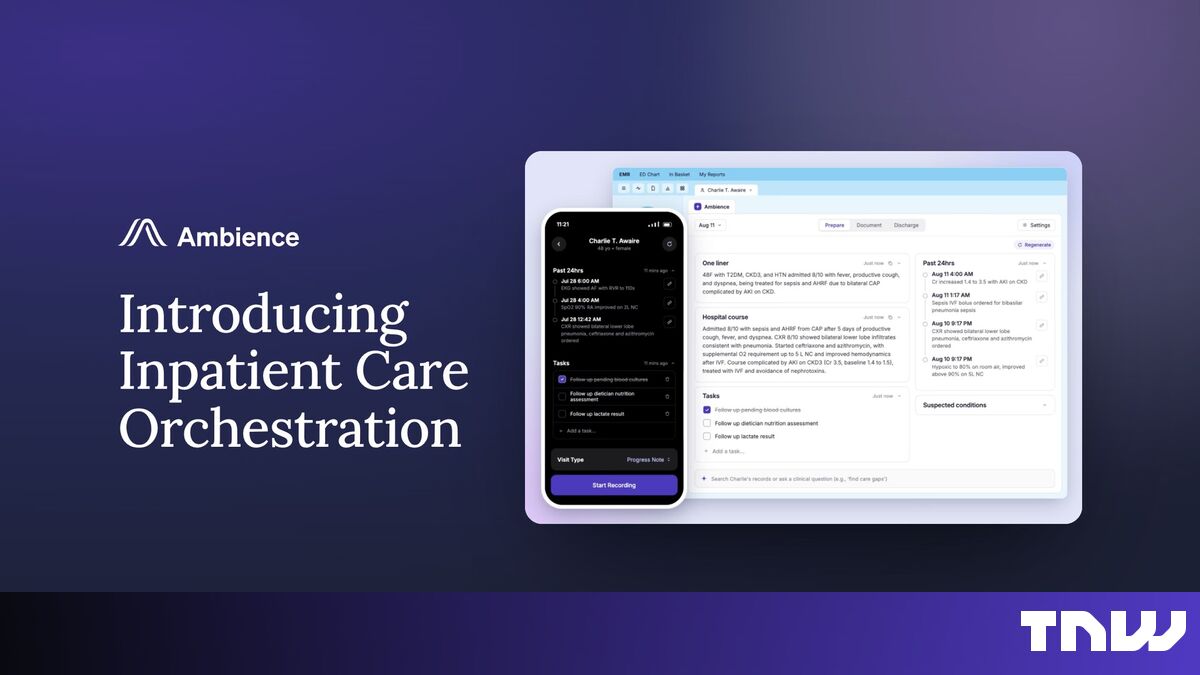
Ambience Healthcare Expands Clinical AI Suite for Hospital Operations
Ambience Healthcare has launched new AI tools designed to assist hospital staff with patient rounding and discharge planning, aiming to improve both clinical efficiency a…
 ⚖️Regulation & Policy
AWS Highlights Enterprise Governance and AI Workspace Quick Ahead of re:Invent 2026
Amazon Web Services is spotlighting its workplace AI platform, AWS Quick, ahead of its upcoming re:Invent 2026 conference, emphasizing secure deployment across major ente…