Amazon Introduces AI-Driven Pipeline to Convert Mainframe Assembler Code into Java
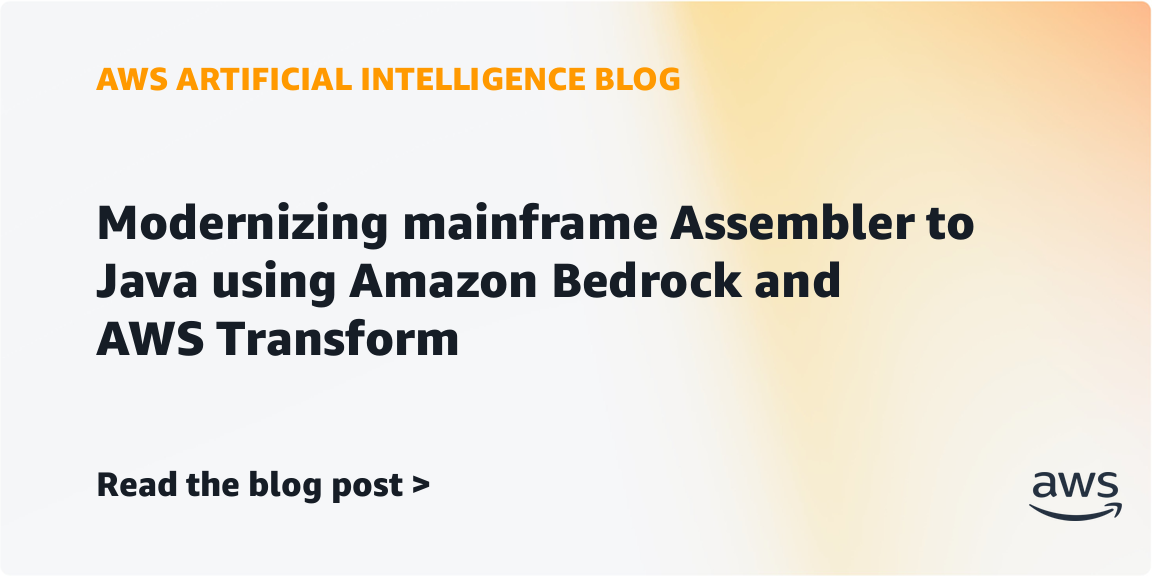
Amazon Web Services has detailed a structured, multi-phase methodology utilizing Amazon Bedrock and AWS Transform to modernize legacy mainframe Assembler code into Java Spring Boot applications.
 🧠AI Analysis
Photo: AWS Machine Learning Blog
Key points
- AWS introduced an AI-powered pipeline to modernize legacy mainframe Assembler code into Java Spring Boot services.
- The methodology uses Amazon Bedrock, Kiro IDE, and AWS Transform across a multi-phase framework.
- An intermediate COBOL stage is utilized to allow human validation of business rules before final cloud conversion.
Amazon Web Services has released a technical framework addressing a persistent enterprise challenge: aging mainframe systems running decades-old Assembler code. As the engineers who understand these legacy programs near retirement, financial institutions, insurers, and airlines face mounting risks when attempting manual rewrites. To mitigate this, AWS is pairing Amazon Bedrock, the Kiro IDE, and AWS Transform to automate the migration process while safeguarding core business logic.
The newly outlined modernization strategy relies on a systematic five-phase approach that introduces an intermediate COBOL stage. Rather than attempting a direct leap from low-level Assembler instructions to modern object-oriented code, the workflow first extracts business rules and translates the legacy code into a readable COBOL format. This intermediate step allows human subject matter experts to validate functional equivalence before AWS Transform converts the codebase into Java Spring Boot services built for the cloud.
According to AWS, utilizing generative AI for code analysis and specification generation significantly cuts down the time required compared to manual approaches. Validation checkpoints are embedded throughout the pipeline—spanning business rule extraction, data flow mapping, and intermediate conversions—to ensure operational continuity for critical nightly batch jobs running on infrastructure like IBM z/OS.
What to watch next: Monitor enterprise adoption rates of AI-assisted mainframe migration tools as financial and aviation sectors seek safe pathways off legacy hardware.
Read next
 🏢Big Tech
United Launch Alliance Investigates Vulcan Rocket Failure
United Launch Alliance is investigating a mission failure of its Vulcan rocket, which suffered from low booster performance shortly after liftoff. The incident raises que…
 🌐Work & Society
US Southwest Hydropower Output Hits Record Lows Amid Persistent Drought
Hydropower generation in the US Southwest dropped 28% below the 10-year average this summer as record-low water levels in the Colorado River Basin threaten regional energ…
 🏢Big Tech
YouTube Updates View Metrics to Include TV Co-Viewing Estimates
YouTube is incorporating estimated co-viewing data into its public view counts to better reflect group consumption on television sets.
 🏢Big Tech
Apple Services Experience Widespread Outage
Apple users are reporting significant disruptions across iCloud, the App Store, and other core services, despite initial discrepancies in the company's status reporting.
 ⚖️Regulation & Policy
OpenAI Partners with Chilean Ministry to Advance Public Sector AI
OpenAI has signed a non-binding agreement with Chile's science ministry to integrate artificial intelligence into public administration and support local startups.
 🌐Work & Society
Ambience Healthcare Expands Clinical AI Suite for Hospital Operations
Ambience Healthcare has launched new AI tools designed to assist hospital staff with patient rounding and discharge planning, aiming to improve both clinical efficiency a…