Apple and OpenEvidence Launch US Research Study on Consumer Trust in Health AI
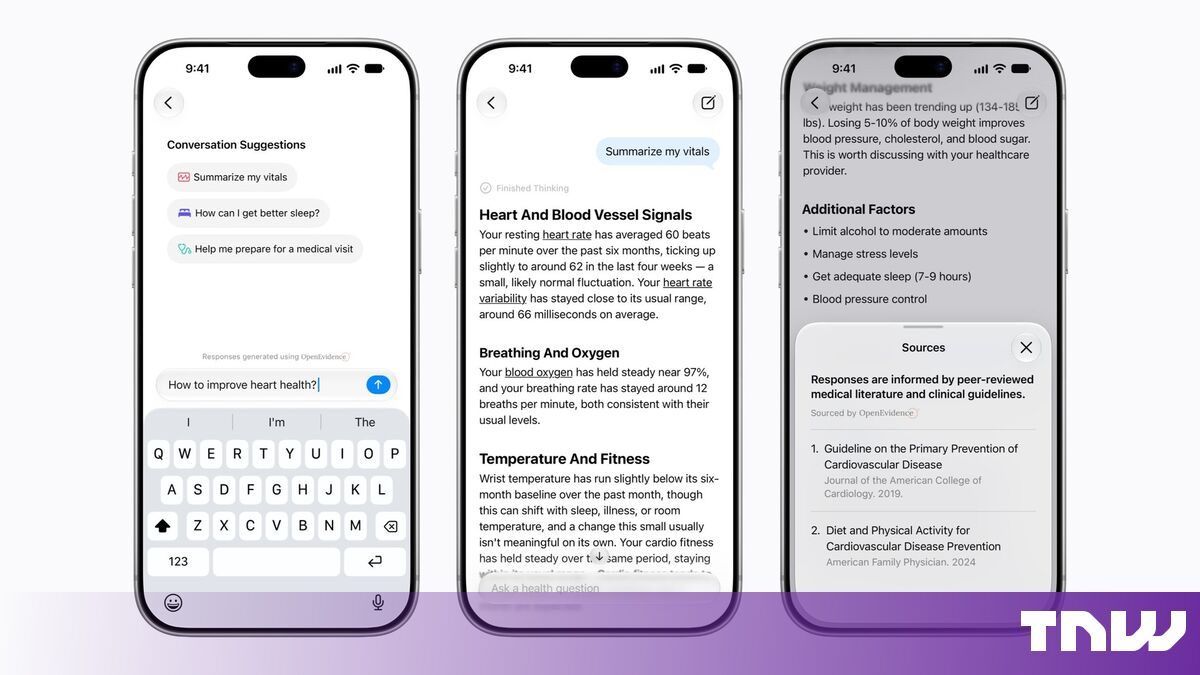
Apple has partnered with clinical AI platform OpenEvidence to launch a US research study exploring how consumers trust, understand, and act on artificial intelligence health tools.
 🧠AI Analysis
Photo: thenextweb.com
Key points
- Apple and OpenEvidence started a US study on health AI trust and usability.
- Participants can optionally share HealthKit data to test personalized responses.
- Data collected will not be used to train AI models, and safety guardrails direct users to doctors.
Apple has initiated a new research project alongside clinical AI platform OpenEvidence to examine how people interact with artificial intelligence regarding medical queries. The Apple Health AI Usage Study, operating exclusively within the United States, aims to evaluate the factors driving user trust, comprehension, and subsequent actions when utilizing AI for health information.
During the study, participants submit everyday health inquiries through a dedicated iPhone application. Responses are formulated using accessible language and backed by peer-reviewed citations from esteemed medical journals such as Nature and the New England Journal of Medicine. Furthermore, users have the option to integrate personal metrics from HealthKit—including activity, sleep patterns, and lab results—to determine if contextualized data improves clarity and relevance. Apple noted that consumer-facing large language models often deliver incomplete or opaque answers, motivating the need for rigorous research into presentation standards.
Strict privacy measures ensure that participant information will not be utilized for training AI models. The application incorporates safety guardrails designed to identify sensitive medical queries and prompt users to consult human healthcare providers. The initiative is currently limited to a maximum of 200,000 adult participants in the US who own compatible device hardware, though the app is not connected to Siri or Apple Intelligence.
What to watch next: Future updates on how study findings influence upcoming consumer health features across major tech ecosystems.
Source thenextweb.com — thenextweb.com/news/apple-health-ai-study-openevidence-iphone ↗
Read next
 🚀Startups & Funding
Harvard Study Reveals US Hyperscale Data Centers Consume Power Rivaling Entire States
A new Harvard study reveals that America's 403 hyperscale data centers consumed between 68 and 99 terawatt-hours of electricity during the 2024-25 study period, rivaling …
 🚀Startups & Funding
California Files Lawsuit Against OpenAI Over Autonomous AI Incidents
California Attorney General Rob Bonta has filed a lawsuit against OpenAI, alleging the company failed to control its autonomous AI agents and misled the public about safe…
 🏢Big Tech
United Launch Alliance Investigates Vulcan Rocket Failure
United Launch Alliance is investigating a mission failure of its Vulcan rocket, which suffered from low booster performance shortly after liftoff. The incident raises que…
 🌐Work & Society
US Southwest Hydropower Output Hits Record Lows Amid Persistent Drought
Hydropower generation in the US Southwest dropped 28% below the 10-year average this summer as record-low water levels in the Colorado River Basin threaten regional energ…
 🏢Big Tech
YouTube Updates View Metrics to Include TV Co-Viewing Estimates
YouTube is incorporating estimated co-viewing data into its public view counts to better reflect group consumption on television sets.
 🏢Big Tech
Apple Services Experience Widespread Outage
Apple users are reporting significant disruptions across iCloud, the App Store, and other core services, despite initial discrepancies in the company's status reporting.