Energy-Based Reasoners Promise Massive Efficiency Gains for AI Inference
Researchers have introduced Energy-Based Reasoners (EBRs), a new approach to multi-step AI reasoning that utilizes gradient descent on an energy function to drastically reduce computational overhead.
 🤖AI Models
Photo: Hacker News Front Page
Key points
- Energy-Based Reasoners use gradient descent on an energy function to guide AI reasoning.
- The architecture achieved 99.9% accuracy on Sudoku-Extreme benchmarks.
- EBRs require up to 345 times less inference compute compared to previous recurrent reasoning models.
A new architectural approach called Energy-Based Reasoners (EBRs) has been proposed to tackle the high computational costs associated with multi-step AI reasoning. Traditional looped models often scale their effective depth by repeatedly iterating a recurrent block, but they typically lack an explicit mechanism to measure progress, determine when to stop, or evaluate how to refine current states.
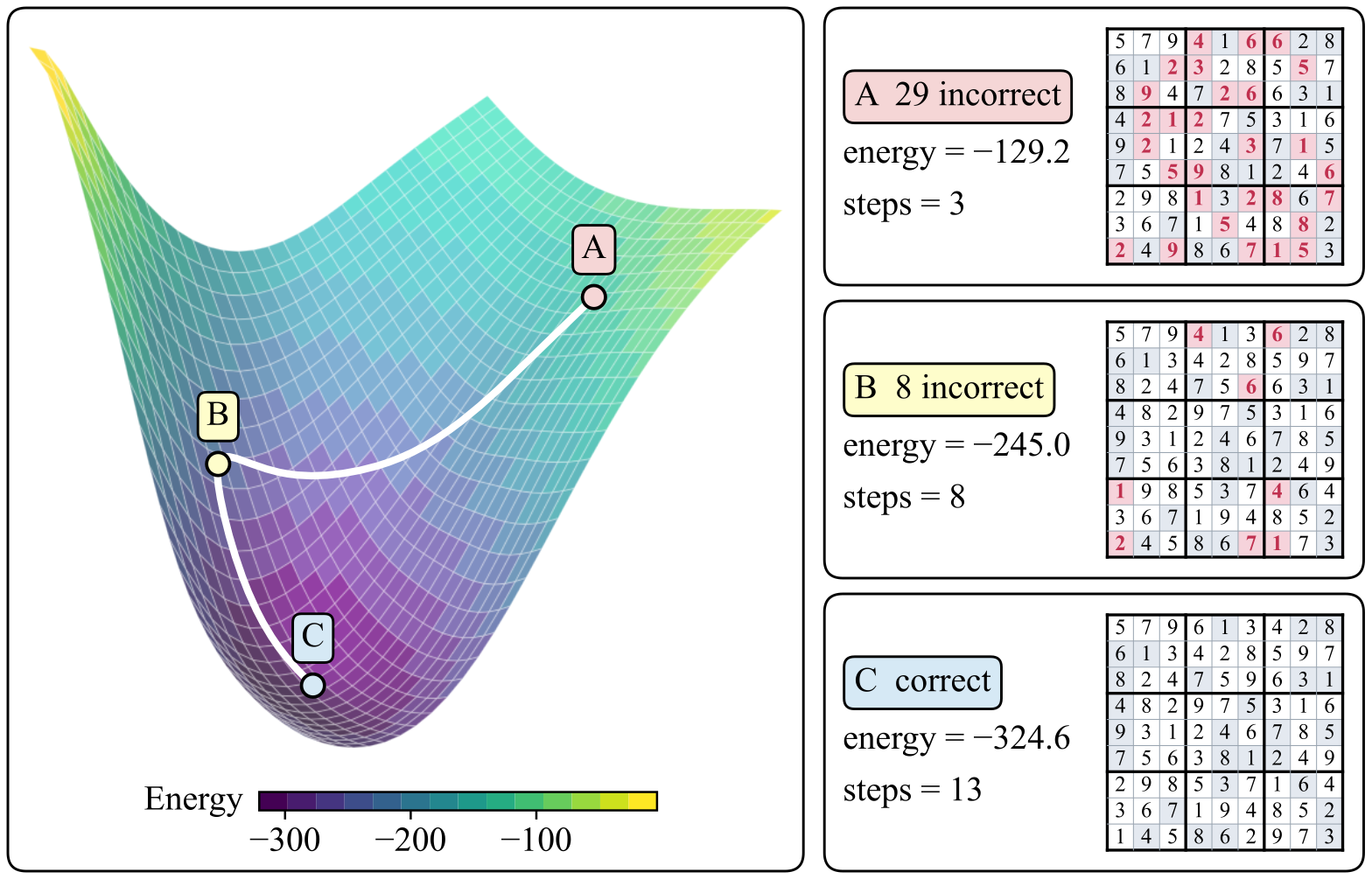
EBRs address this limitation by learning an energy function that scores latent reasoning states. By formulating looped updates as gradient descent on this energy, the model uses the resulting gradient to guide refinement, establish a natural stopping criterion, and select the optimal solution among multiple candidates. According to the research, correct solutions naturally settle at low-energy stationary states where gradients become small.
Across four algorithmic reasoning benchmarks, EBRs demonstrated strong performance, matching or outperforming prior recurrent reasoning models. Notably, the architecture achieved a 99.9% accuracy rate on Sudoku-Extreme while utilizing up to 345 times less inference compute than alternative models. Furthermore, the approach requires fewer iterations and samples to reach top-tier accuracy.
What to watch next: Watch for whether these energy-based methods scale effectively to larger, more complex language model tasks beyond algorithmic benchmarks.
Source Hacker News Front Page — energy-based-reasoners.github.io/ ↗
Read next
 🧠AI Analysis
Salesforce Optimizes Global AI Model Inference with Amazon SageMaker
Salesforce has implemented cross-Region inference routing in Amazon SageMaker to manage AI model capacity across 30+ global regions more efficiently.
 🚀Startups & Funding
OpenAI CEO Sam Altman Addresses Upcoming Biographical Film
OpenAI CEO Sam Altman commented on the upcoming film 'Artificial,' which portrays his life and the 2023 leadership crisis at the company.
 🔌Chips & Hardware
Snapchat Integrates AI Coding Assistants into AR Lens Development
Snapchat has launched the Easy Lens CLI, enabling developers to build augmented reality experiences using AI coding tools like Claude Code and Cursor.
 🚀Startups & Funding
RadixArk Unveils DaisyRose-27B, Focused on Agentic Efficiency
Startup RadixArk has launched DaisyRose-27B, an AI model optimized for long-horizon agent tasks, claiming significant improvements in training efficiency and reasoning ca…
 🔌Chips & Hardware
US Eyes the Philippines for Massive AI and Chip Hub Amid Domestic Opposition
President Donald Trump visited the Philippines to advance the Pax Silica initiative, proposing a 1,620-hectare hub for data centers and chip fabs to bypass local pushback…
 🚀Startups & Funding
Best Buy Reintroduces Physical Media After Brief Exit
Best Buy has resumed selling Blu-ray discs directly through its website and physical retail locations, reversing a policy that saw the retailer exit the physical media ma…