Airbnb Researchers Unveil CASTLE Framework to Train Search Models Using Synthetic Data
Airbnb has introduced CASTLE, a new framework that uses large language models and de-identified booking data to generate synthetic search queries and relevance labels for natural language search.
 🤖AI Models
Photo: infoq.com
Key points
- Airbnb introduces CASTLE to tackle the cold-start problem in natural language search.
- The framework generates synthetic queries and relevance labels jointly using large language models and booking session data.
- In testing, CASTLE achieved a 9.2-fold reduction in distribution divergence compared to previous baselines.
Researchers at Airbnb have developed a framework named CASTLE to solve the cold-start problem in natural language search systems. By leveraging de-identified booking sessions and large language models, the approach generates synthetic search queries alongside relevance labels simultaneously, allowing models to be trained effectively before real search traffic builds up.
Natural language search allows users to look for accommodations using everyday conversational phrases like "pet-friendly beach house that sleeps eight" instead of relying strictly on standard filters. Traditional training methods usually separate query generation and relevance labeling into distinct steps, which can introduce errors and discrepancies between artificial and actual user behavior. CASTLE avoids this by utilizing contrastive listing pairs from past bookings, where a booked property acts as a positive example and an alternative viewed property acts as a negative one.
The system integrates template-based prompts, few-shot prompting utilizing seed queries from user research, and attribute-grounded prompts to create realistic variations in query length and phrasing. For new properties lacking historical booking data, the framework employs an LLM-based Virtual Judge to assign relevance labels. In evaluations, CASTLE achieved a significantly lower Kullback-Leibler divergence against real user query distributions compared to existing baselines, and human evaluators agreed with its relevance assignments up to 93 percent of the time.
What to watch next: Further investigations into strict data splitting methods to separate the learning of user intent from familiar property templates.
Source infoq.com — infoq.com/news/2026/11/airbnb-castle/?utm_campaign=infoq_content&ut… ↗
Read next
 🧠AI Analysis
Salesforce Optimizes Global AI Model Inference with Amazon SageMaker
Salesforce has implemented cross-Region inference routing in Amazon SageMaker to manage AI model capacity across 30+ global regions more efficiently.
 🏢Big Tech
Microsoft Challenges Rivals on AI Pricing at Ignite Conference
Microsoft is positioning its Copilot AI as the more cost-effective choice for businesses compared to OpenAI and Anthropic, citing a commissioned study to support its clai…
 🚀Startups & Funding
OpenAI CEO Sam Altman Addresses Upcoming Biographical Film
OpenAI CEO Sam Altman commented on the upcoming film 'Artificial,' which portrays his life and the 2023 leadership crisis at the company.
 🌐Work & Society
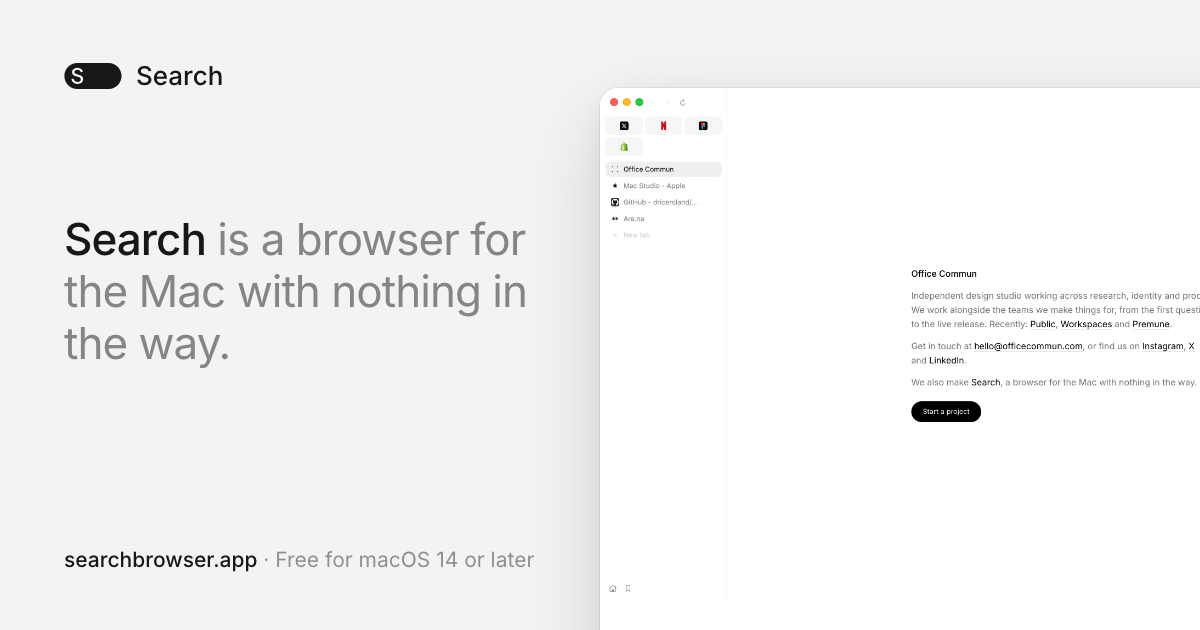
Design Studio Office Commun Launches Minimalist WebKit Browser for macOS
Paris-based design studio Office Commun has released Search, a lightweight, open-source web browser for macOS that prioritizes performance and minimalist design.
 🔌Chips & Hardware
Snapchat Integrates AI Coding Assistants into AR Lens Development
Snapchat has launched the Easy Lens CLI, enabling developers to build augmented reality experiences using AI coding tools like Claude Code and Cursor.
 🚀Startups & Funding
RadixArk Unveils DaisyRose-27B, Focused on Agentic Efficiency
Startup RadixArk has launched DaisyRose-27B, an AI model optimized for long-horizon agent tasks, claiming significant improvements in training efficiency and reasoning ca…